
 English
 Spanish
BYOD Monitoring Policy: Company-Owned vs. Personal Devices
Posted in Mobile Tracking by admin
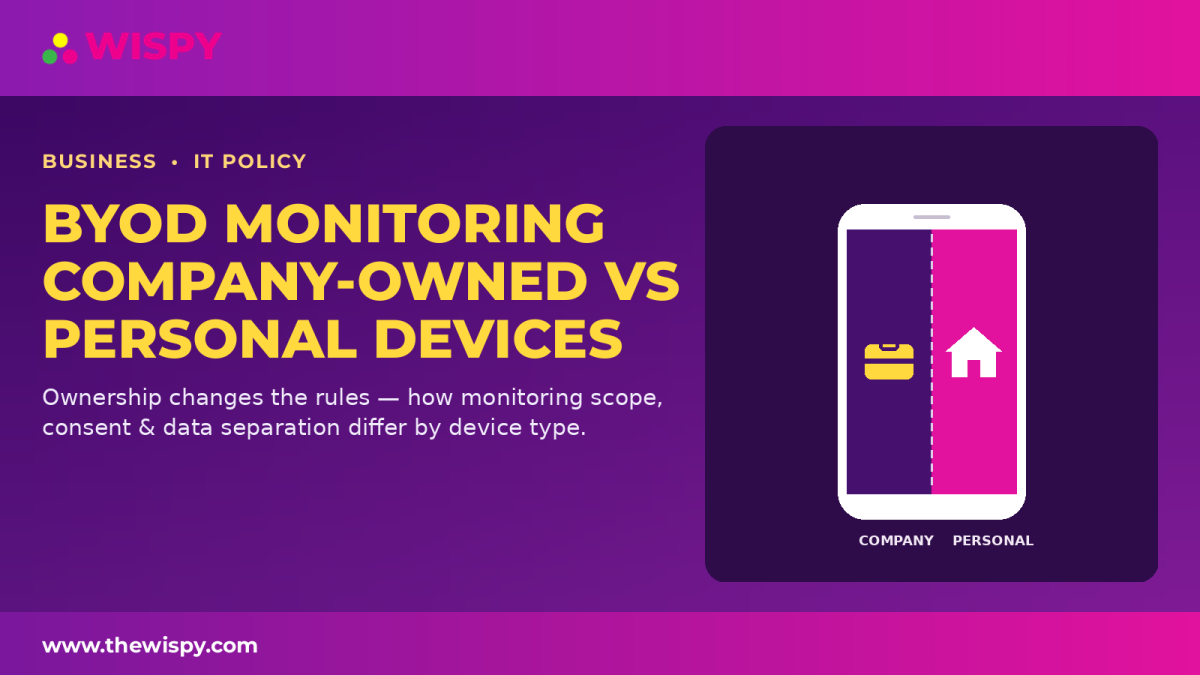
A BYOD monitoring policy needs to account for a fundamental difference: whether a device belongs to the company or the employee. Ownership can affect how monitoring should be designed, what information is appropriate to collect, and what privacy and legal considerations may apply. Company-owned devices and personal devices should not automatically be treated the same way. A well-designed monitoring program should consider ownership, business purpose, employee expectations, consent, and the technical ability to separate work data from personal information. For additional background on securing BYOD devices, see the CISA guidance on securing organizational and BYOD devices. Device ownership is one of the most important factors when developing an employee monitoring policy. A company-owned phone is organizational property, while a BYOD phone is an employee’s personal property that happens to be used for work. That distinction can affect the appropriate scope of monitoring, the employee’s expectation of privacy, the need for notice and consent, and how company data should be separated from personal information. The core challenge with BYOD monitoring is that one device contains both work and personal information. An employee may use the same smartphone for company email, personal messages, photographs, banking, social media, and other private activities. A monitoring system designed without proper separation could potentially capture information that has nothing to do with the employee’s work. That is why a strong BYOD monitoring policy should clearly define what the organization needs to monitor and what it does not need to access. Whenever possible, businesses should use technical controls that separate corporate information from personal information. Work profiles, application containers, and mobile device management tools can help organizations manage business applications without requiring broad access to personal content. CISA has described containerization as one approach for separating corporate applications and data from personal areas of a mobile device. A BYOD monitoring policy should explain why monitoring is necessary. Examples might include protecting company data, enforcing security requirements, managing access to corporate systems, or investigating legitimate security incidents. The scope should then be limited to information reasonably connected to that purpose. The monitoring approach can differ significantly depending on who owns the device. For related guidance, see our employee monitoring policy template and our employee monitoring legality guide. Mobile Device Management (MDM) can provide a more controlled alternative to broad device-monitoring software. Rather than giving an organization unrestricted visibility into an employee’s personal phone, an appropriately configured MDM deployment can manage specific work applications, accounts, security settings, and corporate data. This approach can be especially useful when the organization’s primary concern is protecting company information rather than monitoring everything an employee does on their personal device. CISA guidance also identifies enterprise mobile-device management capabilities such as authentication requirements and the ability to remove agency data from managed devices as important security controls. A written policy should be specific enough that employees understand what happens when they use a personal device for work. Explain why the organization monitors or manages BYOD devices. Avoid vague language such as “the company may monitor your device.” Instead, describe the specific business and security purposes involved. Clearly identify whether the organization can access work email, corporate applications, company files, security logs, VPN activity, or other business information. Also identify categories of personal information that are outside the monitoring scope whenever appropriate. Employees should understand what information is collected, how it is used, who can access it, and how long it may be retained. A BYOD policy should explain how company data is removed from a personal device when an employee leaves the organization or stops participating in the BYOD program. Businesses may establish conditions for using personal devices for work, but the appropriate requirements depend on the jurisdiction, the monitoring technology, the information collected, and the organization’s policies. Any BYOD program should be clearly disclosed and appropriately scoped, with legal review where necessary. No. A properly configured work profile or container is intended to separate business applications and data from personal information. Full-device monitoring can potentially provide much broader visibility and therefore creates different privacy and compliance considerations. Accidental collection of personal information is an important warning sign that the monitoring system may be too broad. Businesses should review the technology, reduce the scope of collection, and consider using a work profile or containerized approach where appropriate. For organizations with substantial security or monitoring requirements, company-owned devices can make device management and data separation easier because the organization controls the hardware. However, company-owned devices still require appropriate policies, security controls, notice, and compliance with applicable laws. Not necessarily. Some organizations permit reasonable personal use while restricting access to or movement of company data. The appropriate approach depends on the organization’s security requirements and the technology used to separate business and personal information. Company-owned devices and BYOD devices should not automatically be monitored in the same way. Company-owned devices generally provide an organization with greater control, while personal devices require a more carefully limited approach because work and private information exist on the same hardware. A strong BYOD monitoring policy should focus on legitimate business purposes, clear notice, appropriate consent, data minimization, and technical separation between work and personal information. For many organizations, MDM, work profiles, and containerization offer a better solution than unrestricted monitoring software. When the business does not genuinely need access to a personal device, providing company-owned equipment may be the simpler option. For additional information about securing mobile devices, review the CISA guidance on protecting data stored on devices. This article is for general informational purposes and is not legal advice. Monitoring and privacy requirements vary by jurisdiction and circumstances. Consult a qualified employment or privacy attorney for guidance specific to your business.BYOD Monitoring Policy: Why Device Ownership Matters
Company-Owned vs. BYOD Monitoring
Consideration Company-Owned Devices BYOD Personal Devices Ownership Owned and controlled by the company Owned by the employee Monitoring scope Can generally be broader when justified by a legitimate business purpose Should be narrowly limited to work-related data, apps, and systems Privacy expectations Employees generally have a lower expectation of privacy when using employer equipment, subject to applicable law and policy Employees generally have a stronger expectation of privacy because the device is personal Consent and notice Clear written notice is a strong best practice and may be legally required in some jurisdictions Clear notice and appropriate consent are particularly important because work and personal data coexist Technical approach Full-device management may be appropriate depending on the business need Work profiles, containers, or other separation technologies are generally preferable Why BYOD Monitoring Requires a Narrower Policy
Keep Work and Personal Data Separate
Limit Monitoring to a Legitimate Business Purpose
BYOD Monitoring Policy vs. Company-Owned Device Monitoring
Best Practices for Company-Owned Devices
Best Practices for BYOD Devices
MDM and BYOD Monitoring Policy
How MDM Can Help With BYOD
What Should a BYOD Monitoring Policy Include?
Define the Purpose of Monitoring
Define What Can Be Accessed
Explain Data Collection and Retention
Explain What Happens When Employment Ends
Frequently Asked Questions About BYOD Monitoring Policy
Can I require employees to install monitoring software on personal phones?
Is a work profile the same as full-device monitoring?
What happens if BYOD monitoring accidentally captures personal data?
Is a company-owned phone simpler than BYOD?
Should a BYOD monitoring policy prohibit personal use?
BYOD Monitoring Policy: The Bottom Line

Related Posts
Mobile Tracker Apps: How They Work and Top 5 Benefits
Have you ever wondered how mobile tracker apps find the...
Read More
Is it Possible to Track Cell Phone Location for Free?
Can you track cell phone location for free? Yes, and...
Read More
How to Track IMEI Number: 5 Ways to Find Your Lost Phone
Can you track IMEI number details to find a lost...
Read More
Install TheWiSpy Monitor App Now and Start Exploring Your Kid’s and Employee’s Digital Space
- Protect Your Kids
- Secure Your Business
- Backup Personal Data

 Affiliate Login
 Spanish