
 English
 Spanish
Phone Rules for Teens Without Spying: A Practical Guide
Posted in Mobile Tracking by admin
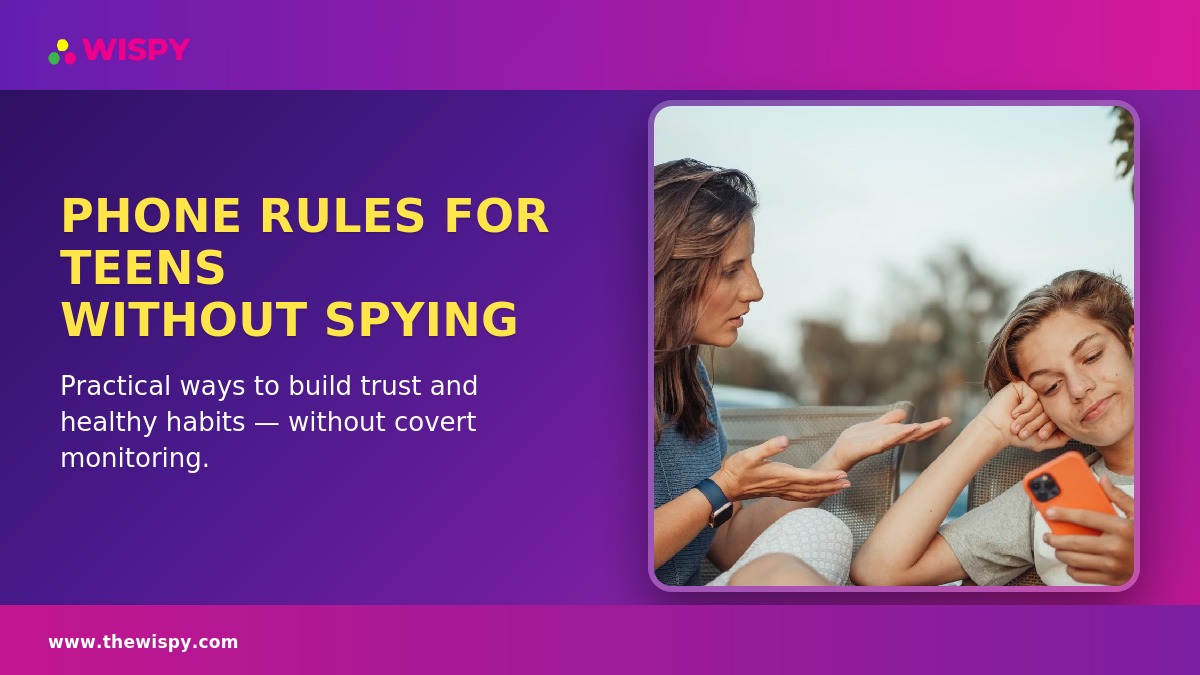
Not every family situation calls for monitoring software. If you’re searching for phone rules for teens without spying, the good news is that for many households, well-structured rules and open communication do most of the work — especially without a specific acute safety concern. Here’s how to build a phone-use approach that doesn’t depend on covert oversight.
Setting Phone Rules for Teens Without Spying: Start With Household Norms
Rules that apply to the whole household tend to land better than rules aimed only at kids. They feel less like targeted suspicion. Phone-free dinners, no phones in bedrooms overnight, and a shared charging station outside bedrooms are good examples. These structural rules reduce risk and build habits. They don’t require anyone to review anyone else’s activity — which is the whole point of setting phone rules for teens without spying.
Use Built-In Platform Tools Before Reaching for Monitoring Software
Most major platforms now have substantial parental features that don’t require covert monitoring:
- Instagram’s Teen Accounts and Supervision (see our Instagram safety guide) — restricts defaults and gives activity visibility without message content access
- Snapchat’s Family Center — shows who a teen is connected with, without reading message content
- Screen Time (iOS) / Digital Wellbeing (Android) — built-in, device-level tools for app limits and downtime scheduling
- Router-level content filtering — blocks categories of content at the network level, applying to all devices in the home without per-app monitoring
For a deeper look at age-appropriate settings across platforms, Common Sense Media’s parental controls guide is a useful outside resource to bookmark alongside your household plan.
Build an Explicit Family Media Agreement
A simple, written agreement tends to work better than unstated expectations, and it’s one of the most effective phone rules for teens without spying that you can put in place. It doesn’t need to be formal. Both you and your teen should sign onto it. Cover:
- Phone-free times and zones, such as meals, bedrooms overnight, and homework time
- What’s expected before adding a new app or platform
- What happens if a rule is broken, decided in advance rather than in the moment
- A process for revisiting the agreement as your teen gets older
Focus on Modeling, Not Just Rules
Household phone rules work far better when parents follow similar norms. A phone-free dinner rule loses credibility fast if parents check email at the table. This matters as much as any specific policy.
When Phone Rules for Teens Without Spying Aren’t Enough
Some situations genuinely call for more than household structure alone. Examples include a specific safety concern, evidence of risky online contact, or a documented pattern of struggling with agreed-upon rules despite good-faith effort.
At this point, consider a direct conversation about adding monitoring. Our guide on how to talk to your teen about phone monitoring explains how parents can approach that conversation in a clear and age-appropriate way.
For serious concerns, monitoring without full disclosure may sometimes be warranted. Still, structural and non-monitoring approaches are worth trying first for most everyday concerns.
A Practical Starting Checklist
- Set 2–3 household-wide phone rules that apply to everyone, not just kids
- Turn on the built-in safety features already available on your teen’s specific apps
- Write down expectations together, rather than relying on unstated assumptions
- Revisit the agreement periodically as your teen ages and earns more independence
- Reserve monitoring software for situations where structure and conversation genuinely aren’t giving you the visibility a specific concern requires
Frequently Asked Questions
Do household rules actually work without monitoring?
For many families, yes. This is especially true when rules are collaborative, consistently enforced, and modeled by parents — not only imposed on kids.
At what point should I consider monitoring instead of just rules?
When there’s a specific, serious concern that structural rules and conversation haven’t resolved. It shouldn’t be a default first step for general phone-use concerns.
Are built-in platform tools such as Family Center and Teen Accounts enough on their own?
For many families, yes — especially for general safety and habit-building. They do have real limits, such as no message content visibility. Those limits matter more for serious concerns than for everyday habit management.
How do I know when my teen’s phone use has become a bigger problem?
Look beyond the number of hours. Problems become more concerning when phone use consistently disrupts sleep, school, relationships, activities, or your teen’s ability to put the phone down. For more detail, read our guide to signs of phone addiction in teens.
How do I revisit rules as my teen gets older?
Tie loosening restrictions to specific milestones. Use demonstrated responsibility, age, or a defined trial period — not an indefinite, unchanging rule set.
Bottom Line
For most everyday phone-use concerns, household structure, built-in platform tools, and an explicit shared agreement do more good than covert monitoring. They also build habits and trust that monitoring alone doesn’t. Reserve monitoring software for situations where a specific concern genuinely requires it.

Related Posts
Mobile Tracker Apps: How They Work and Top 5 Benefits
Have you ever wondered how mobile tracker apps find the...
Read More
Is it Possible to Track Cell Phone Location for Free?
Can you track cell phone location for free? Yes, and...
Read More
How to Track IMEI Number: 5 Ways to Find Your Lost Phone
Can you track IMEI number details to find a lost...
Read More
Install TheWiSpy Monitor App Now and Start Exploring Your Kid’s and Employee’s Digital Space
- Protect Your Kids
- Secure Your Business
- Backup Personal Data

 Affiliate Login
 Spanish