
 English
 Spanish
Employee Consent Monitoring Law: What Employers Must Document in 2026
Posted in Employee Monitoring by admin
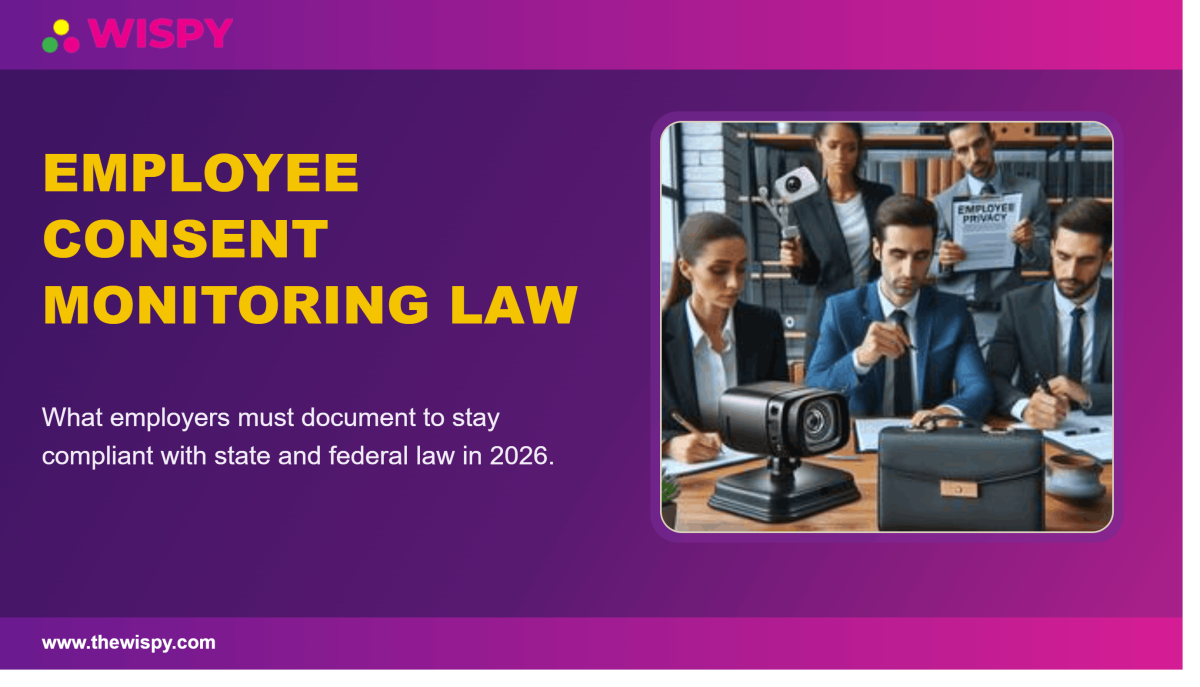
Getting employee consent monitoring law right starts with one uncomfortable fact: there is no single national rulebook. What counts as valid consent depends on which state’s law applies, what kind of monitoring you’re running, and whether the device is company-owned or personal. This guide goes past the general overview — it’s specifically about what actually counts as valid consent under employee consent monitoring law, and how to document it in a way that holds up if it’s ever challenged.
The Federal Starting Point for Employee Monitoring Consent
Under the Electronic Communications Privacy Act (ECPA), employers can generally monitor electronic communications on company systems through two paths: the business purpose exception (a legitimate operational reason for monitoring) or the consent exception (at least one party to the communication has agreed to monitoring). Federal law sets a fairly low bar here — it doesn’t specify what form consent must take, which is exactly where state-level employee consent monitoring law fills in the detail. For a plain-language walkthrough of how the statute is structured, the Bureau of Justice Assistance’s ECPA overview is a useful starting point.
What Counts as Valid Consent (and What Doesn’t)
This is where many businesses get employee consent monitoring law wrong. A single line buried in a lengthy employee handbook that employees may not have read closely is legally weaker evidence of informed consent than a standalone, specifically labeled acknowledgment. For consent to hold up:
- It should be specific — naming what’s being monitored (email, location, calls, screen activity), not a vague reference to company systems
- It should be a distinct action, not bundled into a broader document an employee might sign without reading closely — a standalone signature line or explicit checkbox specifically about monitoring is stronger than a general handbook acknowledgment
- It should be given freely, without being disguised or presented as optional when it’s actually mandatory
- It should be renewed when monitoring scope changes — consent to email monitoring doesn’t automatically extend to a new location-tracking feature added later
State-by-State Employee Monitoring Consent Requirements (2026)
States Requiring Written Notice Before Monitoring Begins
Connecticut, Delaware, New York, and Colorado have established written notice requirements under their respective employee consent monitoring laws. It’s worth noting that California’s **AB 1221**, which would have added significant new requirements — including justifying why more invasive monitoring methods are necessary when less invasive alternatives could achieve the same purpose — did not pass during the 2025–2026 legislative session; you can track its status and text directly on the California Legislature’s bill page. Employers operating in California should still watch for a similar bill to be reintroduced, since the underlying policy pressure hasn’t gone away. Maine’s 2026 update specifically treats continuous screen capture as requiring stronger justification than periodic or activity-based logging.
States Requiring All-Party Consent for Recording
For audio or video recording specifically (as distinct from general activity monitoring), California, Connecticut, Florida, Illinois, Maryland, Massachusetts, Michigan, Montana, Nevada, New Hampshire, Pennsylvania, and Washington require all parties to a recorded conversation to consent — not just the employer’s own consent as one party. This is a meaningfully higher bar than general activity monitoring and needs explicit handling in your consent documentation if call or audio recording is part of your monitoring program.
Biometric-Specific Consent Requirements
If your monitoring or access-control systems use fingerprint, facial recognition, or other biometric identifiers, Illinois’s Biometric Information Privacy Act (BIPA) imposes its own strict written-consent requirements, with a track record of significant enforcement activity. This applies as its own layer of requirement, separate from your general employee consent monitoring law obligations, if biometric data is involved anywhere in your systems.
BYOD-Specific Consent
Monitoring personal devices used for work requires a meaningfully higher consent bar than company-owned equipment in most states. Colorado specifically requires written consent for BYOD monitoring. General company-device consent language does not extend to personal devices — this needs its own explicit, separate consent process. See our related guide on BYOD policy best practices for a template you can adapt.
How to Document Employee Monitoring Consent Properly
- Use a standalone monitoring consent form, separate from your general employee handbook acknowledgment
- List specifically what’s monitored — don’t rely on general language like “company systems and communications”
- Get a dated signature specifically for this document, not a bundled acknowledgment covering multiple policies at once
- Store signed consent records securely and accessibly — if consent is ever challenged, you need to be able to produce the specific document, not just point to a general handbook
- Re-obtain consent when monitoring scope changes — adding a new monitoring capability (like location tracking) after initial consent was given for message monitoring alone creates a gap you’ll want to close with updated consent
What Happens Without Proper Consent Documentation
Monitoring without adequate consent or notice, where required, can expose a business to several forms of legal risk: civil claims under state privacy statutes, regulatory penalties in states with dedicated enforcement mechanisms (Illinois’s BIPA being a notable example with a strong enforcement history), and, in some cases, evidence obtained through improperly consented monitoring being excluded from use in a related legal dispute. Beyond the legal exposure, discovering undisclosed monitoring tends to damage trust significantly more than the monitoring itself would have, had it been properly disclosed from the start.
A Practical Employee Consent Monitoring Law Checklist
- Build a standalone, specific monitoring consent document — not a buried handbook clause
- Identify whether any employees are in all-party consent states, and handle audio/video recording consent separately and explicitly
- Confirm whether biometric identifiers are used anywhere in your monitoring or access systems, and add BIPA-specific consent if so
- Create a separate, explicit BYOD consent process if personal devices are in scope at all
- Re-obtain consent whenever monitoring scope expands
- Store signed consent documentation securely, in a form you can produce if ever challenged
Frequently Asked Questions About Employee Consent Monitoring Law
Is a general handbook acknowledgment enough for monitoring consent?
It’s legally weaker than a standalone, specific monitoring consent document — courts and regulators increasingly look for evidence that an employee specifically understood and agreed to monitoring, not just that they signed a general handbook at some point.
Does consent need to be renewed periodically, even if monitoring hasn’t changed?
Not necessarily on a fixed schedule, but it should be renewed whenever the scope of monitoring changes meaningfully — adding a new type of tracking or a new device category, for example.
What if an employee refuses to consent to monitoring?
This varies by state and by whether monitoring is a condition of employment or device use; in many cases, employers can make monitoring consent a condition of using company systems or devices, but this should be handled clearly and consistently, not selectively.
Does consent obtained in one state cover an employee who later relocates to a stricter state?
Generally no — if an employee moves to a state with different requirements, it’s worth reviewing whether your existing consent documentation still meets that state’s specific standard.
Bottom Line
Valid employee consent monitoring law compliance in 2026 means specific, standalone, properly documented agreement — not a line buried in a handbook. Given how much state requirements vary, and how quickly they’re changing, building your consent process around your strictest-requirement state, rather than the federal minimum, is the more defensible approach for any multi-state employer.
This article is for general informational purposes and isn’t legal advice. Consult a licensed employment attorney for guidance specific to your business and the states where you operate.

Related Posts
Employee Productivity Monitoring Signs: What to Watch
Employee productivity monitoring signs can appear in company phone activity....
Read More
What Is Employee Monitoring Software? A Quick Overview
Employee monitoring software is a category of tools businesses use...
Read More
Best Employee Monitoring Apps Compared (2026)
Finding the best employee monitoring apps for your team means...
Read More
Install TheWiSpy Monitor App Now and Start Exploring Your Kid’s and Employee’s Digital Space
- Protect Your Kids
- Secure Your Business
- Backup Personal Data

 Affiliate Login
 Spanish